Sizing
How to Calculate Nickel Strip Size for Your Battery Pack Current (With Worked Examples)
Strip that is too small runs hot. Strip that is too big wastes money and is hard to weld. Instead of guessing, use three simple steps: find the current in the strip, find the cross-section you have, and check the heat. The numbers below are plain arithmetic you can repeat on a calculator.
Step 1: find the current in the strip
Strips in different places carry different current. A strip between cells in one parallel group carries only that cell's share. A series link carries the full pack current. So a 40 A pack with 6 cells in parallel has about 6.7 A per cell, but 40 A in each series link.
Step 2: find the cross-section
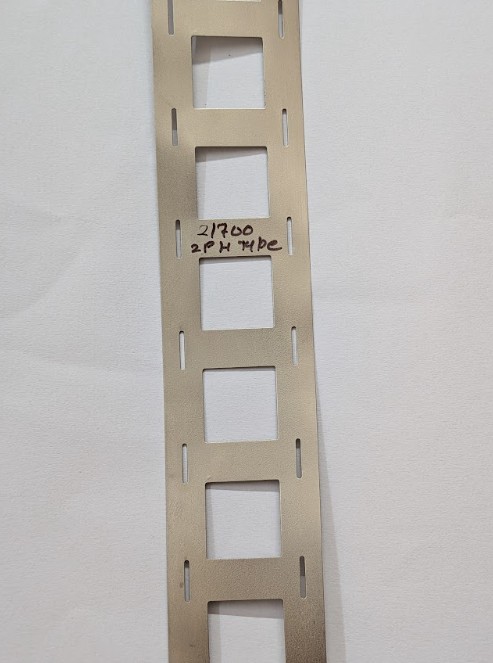
Cross-section (mm²) is width times thickness. For pre-cut 2P strips the cut-outs reduce the real section, so measure the narrowest part.
| Strip | Cross-section | Resistance per 10 mm (pure nickel) |
|---|---|---|
| 6 x 0.15 mm | 0.90 mm² | 0.78 mΩ |
| 8 x 0.15 mm | 1.20 mm² | 0.58 mΩ |
| 10 x 0.15 mm | 1.50 mm² | 0.47 mΩ |
| 10 x 0.20 mm | 2.00 mm² | 0.35 mΩ |
| 8 x 0.30 mm | 2.40 mm² | 0.29 mΩ |
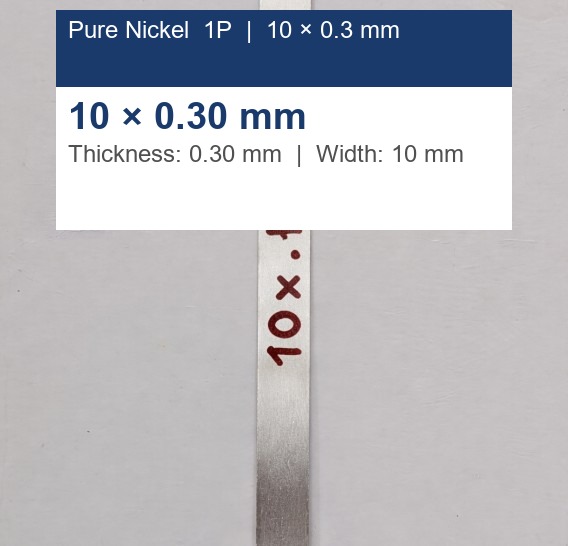
| 10 x 0.30 mm | 3.00 mm² | 0.23 mΩ |
Step 3: check the resistance and heat
Resistance is R = ρ x L / A. For nickel, ρ is about 0.07 Ω·mm²/m (roughly 7 µΩ·cm), so a 10 mm length has a resistance of about 0.7 / A mΩ, with A in mm². That is how the table above was made. Heat in the strip is I² x R.
Worked example. A 10 mm piece of 8 x 0.15 mm pure nickel is 0.58 mΩ. At 20 A it dissipates 20² x 0.00058 = 0.23 W. The same length of 10 x 0.30 mm is 0.23 mΩ, which is 0.093 W at 20 A, less than half the heat. Small numbers, but a pack has many joints, in a closed box, in an Indian summer.
Plated steel runs hotter. A steel core has roughly twice the resistivity of nickel, or more, so a plated strip of the same size dissipates correspondingly more heat. This is why pure nickel is preferred for heavy loads and plated strip for lighter ones.
Rules of thumb that save mistakes
- Size series links for the peak pack current, not the average.
- Add strips in parallel (layers or side by side) when one strip is not enough.
- Past a few tens of amps, consider copper busbar.
- Joint quality matters as much as strip size. A weak weld adds resistance on its own; see pack heating troubleshooting.
- Always confirm with a temperature test at full load.
See also our 18650 vs 21700 vs 32650 sizing guide.
The figures use standard resistivity values for pure nickel and give a starting point only. Real strips, welds and temperatures vary. Validate with your own tests.
Strip sizes to choose from
Live stock and price from our store. Tap a product to add it to your quote.
Loading products…
Frequently asked questions
How do I find the current rating of nickel strip?
There is no single rating, because it depends on allowed temperature rise, strip length and cooling. Calculate resistance and heat for your current as shown here, then confirm with a load test.
What is the resistance of 8 x 0.15 mm nickel strip?
For pure nickel, about 0.58 mΩ per 10 mm of length, from 0.07 Ω·mm²/m divided by the 1.2 mm² cross-section.
Is plated steel strip worse than pure nickel for current?
Yes. The steel core has higher resistance, so the same size runs hotter. It remains fine for lighter loads.
How can I carry more current without changing the strip size?
Add strips in parallel, shorten the path, or move the main path to copper busbar.
Do 2P strips carry more current than 1P?
A wider 2P strip has more cross-section, but its cut-outs reduce it. Measure the narrowest section when you calculate.
More from the Arambhika blog
Why Is My Lithium Battery Pack Heating Up? Nickel Strip, Weak Welds and Busbar Fixes
Read blog →
Nickel Strip Price per kg in India: What Decides the Rate (Plated vs Pure)
Read blog →